
International NGO
Project Duration:
4weeks
Interpersonal Conflict Resolution

Visit website

Challenge
The exasperated Board of Directors of an innovative international humanitarian aid organization was experiencing an intolerable conflict between two of its leaders. The interpersonal conflict involved Mary the Executive Director (ED) who had been recruited by the Board two years earlier and Dalia a Regional Director (RD) who had for six years single-handedly kept the regional operations alive and well despite little support from HQ. The ED found it impossible to gain the RD’s collaboration needed in order to move the organization into new directions. The RD had strong support from the Board so the option of removing the RD was viewed as costly.. In contrast the RD found her counterpart unable to fully appreciate the needs and realities of field operations and felt that the ED’s growth and expansion strategy were both unrealistic and unsustainable. The conflict, described as a “personality clash” by the Board, was not only affecting the various teams working at both headquarters and in the field but given the strategic roles of the actors involved, was reaching the point where the organization’s survival was seriously threatened. As the leaders themselves were unable to resolve their differences directly the Board felt it necessary to hire a mediator/coach to help resolve this conflict.
Action
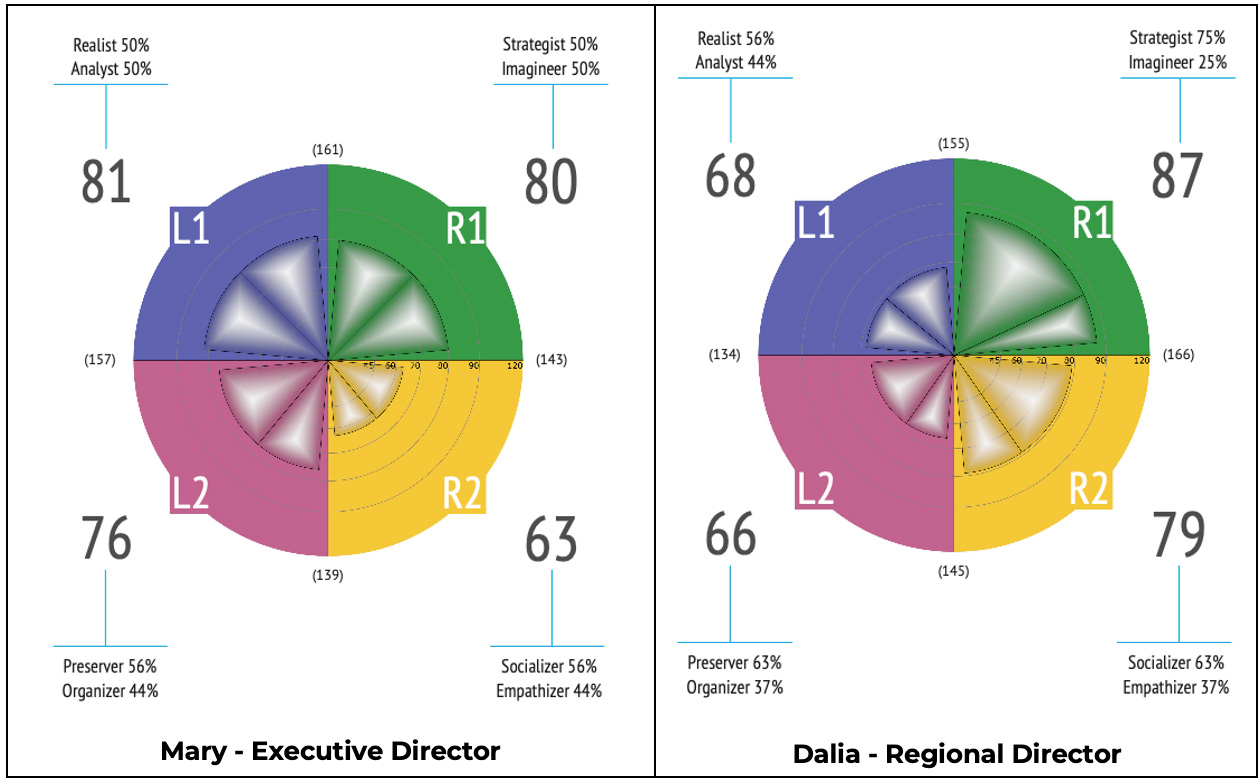
A licensed NBI practitioner with skills in mediation and coaching conducted a series of three 90-minute virtual mediation sessions with the two leaders over the course of one month. The practitioner met first with each leader separately to build rapport and understand the challenges from each leader. During these interviews the practitioner learned that Mary was struggling with what she perceived as Dalia’s excessive need for recognition, empathy and affirmation and the difficulty getting impact data from the regional work that was needed by Mary for fundraising efforts. From Dalia’s perspective, she found the requests for data from Mary to be a nuisance and a distraction from the day-to-day crises and challenges she was facing. Furthermore Mary never seemed to listen to understand the regional situation and had only visited once in 2 years as the ED. The practitioner suspected that differences in thinking preferences might be one important factor among others affecting the dynamic. After each of these 1-1 conversations, the practitioner administered the NBI General Adult assessment the results of which are depicted below.
During the first mediation session, and after letting the two leaders express their frustrations and areas of disagreement fully, the NBI practitioner shared the results of the assessment with both leaders. This helped to shift the focus of the conversation on each person to the NBI framework. It became immediately clear to both leaders why their counterparts valued different types of information and had different styles. This helped reduce stereotyping (e.g. “Dalia is too relational” vs. “Mary is too cold and data oriented”). The combination of the NBI with deep listening assisted the leader to acknowledge and appreciate different thinking styles and communication needs that were present. By the end of the second session the dynamic shifted from a blaming conversation to one of learning and problem-solving
Result
In the 3rd and final mediation session, Mary and Dalia were challenged to imagine what would be possible if their different leadership strengths could be integrated. In other words what would be possible if they combined their strengths and channel them in service of the organization. In the end the two leaders decided to co-design and co-lead a global team retreat and fundraising event the following year which generated significant funding for the organization. Additionally, Mary agreed that she needed to visit the field more often in order to build closer relationships with the team while Dalia understood the importance of data collection and proactively providing impact assessments for Mary for HQ. They also agreed on developing a routine rhythm for calls every 2 weeks and to spend time on each call listening to each other's priorities.
Find Us
NBIAssessments.com is owned and managed by Global Insights Consulting, LLC. a New York City-based company
41 Central Park West
Suite 1G
New York, NY 10023
USA
support@nbiassessments.com
Contact Us
The NBI Assessments are administered through certified practitioners. Contact us today to find out more about how we can help you unleash greater effectiveness both personally and in your organization using the NBI Assessments.
By clicking submit above, you consent to allow NBI Assessments to store and process the personal information submitted above to provide the requested content.
Quick Links
Join Our Mailing list
We're committed to your privacy. NBI Assessments uses the information you provide to us to contact you about our relevant content, products, and services. You may unsubscribe from these communications at any time. For more information, check out our Privacy Policy.